November 2002
Astro Chatter
Swap
Shop
Nasa
Space Article
October
Meeting notes
November
Chart
What's New?
From
Brobdingnag to Lilliput:
My Travels Through 30 Years of the Space Program
By Diane K. Fisher
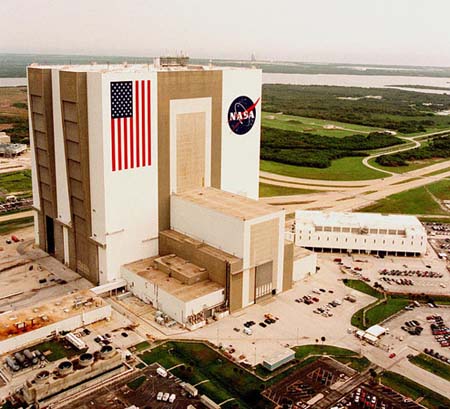
In the early 70s, as minor character in the Apollo Program, I worked in the Vehicle Assembly Building at KSC. Stepping into the VAB, I felt like the incredible shrinking woman. The space inside accommodated six 45-story office towers with vast open spaces to spare. In the vertical spaces between the office towers, the 363-foot high Saturn Vs were assembled.
From my third floor office in one tower, I often delivered documents to higher floors in other towers. Between riding the stomach-dropping glass elevators and dashing across to other towers on narrow, open catwalks at the 28th or 44th floor levels, I soon overcame my fear of heights.
On these excursions, I would see the Saturn Vs come together in the 500-foot high bays. After hundreds of engineers and technicians had toiled around the clock for months, the morning of high-bay rollout would arrive. Slowly, the Crawler Transporter would bear forth the Mobile Launch Platform and the majestic Saturn V rocket. The morning sun reflecting off its gleaming white form would take my breath away.
The last Apollo mission was 30 years ago. As the Apollo program ended, some thought human missions to the Moon, Mars, and beyond would continue apace. Though they didn't continue, the Apollo program remains a single, large step in our technological evolution as a species. It is a great tribute to the intelligence, ingenuity, and dedication of the people responsible for the Apollo missions that they were so successful and the disasters so few. NASA's program today continues to build on the technological and managerial legacy bequeathed us by Apollo.
And just where are we now? Among its other tasks, the International Space Station is teaching people to live in space for long periods. Robotic space missions are studying issues like land use and global warming and discovering the wonders of the universe, its history, and our place in it. With humanity's many other pressing needs, such quests must be done efficiently.
Part of NASA's mission is to develop the technologies to do cost-effectively what has never been done before at all. NASA's New Millennium Program develops and validates new technologies for space. Missions such as Deep Space 1 and Earth Observing 1 carry and test multiple new technologies (such as ion propulsion and advanced imaging instruments) previously untried in space. And, unlike the Saturn V, the ultimate gas-guzzling muscle car of the 70s, the new technologies must be the "zero emission" vehicles of the 21st century-small, efficient, and capable beyond anything done before.
Many of the New Millennium technologies are described for adults at nmp.nasa.gov and for children at The Space Place, spaceplace.nasa.gov.
Diane K. Fisher is the developer and writer for The Space Place web site.
This article was provided by the Jet Propulsion Laboratory, California Institute of Technology, under a contract with the National Aeronautics and Space Administration.
Captions:
The Vehicle Assembly Building at Kennedy Space Center, completed in 1965 for the Apollo Moon Program.
My Travels Through 30 Years of the Space Program
By Diane K. Fisher
In the early 70s, as minor character in the Apollo Program, I worked in the Vehicle Assembly Building at KSC. Stepping into the VAB, I felt like the incredible shrinking woman. The space inside accommodated six 45-story office towers with vast open spaces to spare. In the vertical spaces between the office towers, the 363-foot high Saturn Vs were assembled.
From my third floor office in one tower, I often delivered documents to higher floors in other towers. Between riding the stomach-dropping glass elevators and dashing across to other towers on narrow, open catwalks at the 28th or 44th floor levels, I soon overcame my fear of heights.
On these excursions, I would see the Saturn Vs come together in the 500-foot high bays. After hundreds of engineers and technicians had toiled around the clock for months, the morning of high-bay rollout would arrive. Slowly, the Crawler Transporter would bear forth the Mobile Launch Platform and the majestic Saturn V rocket. The morning sun reflecting off its gleaming white form would take my breath away.
The last Apollo mission was 30 years ago. As the Apollo program ended, some thought human missions to the Moon, Mars, and beyond would continue apace. Though they didn't continue, the Apollo program remains a single, large step in our technological evolution as a species. It is a great tribute to the intelligence, ingenuity, and dedication of the people responsible for the Apollo missions that they were so successful and the disasters so few. NASA's program today continues to build on the technological and managerial legacy bequeathed us by Apollo.
And just where are we now? Among its other tasks, the International Space Station is teaching people to live in space for long periods. Robotic space missions are studying issues like land use and global warming and discovering the wonders of the universe, its history, and our place in it. With humanity's many other pressing needs, such quests must be done efficiently.
Part of NASA's mission is to develop the technologies to do cost-effectively what has never been done before at all. NASA's New Millennium Program develops and validates new technologies for space. Missions such as Deep Space 1 and Earth Observing 1 carry and test multiple new technologies (such as ion propulsion and advanced imaging instruments) previously untried in space. And, unlike the Saturn V, the ultimate gas-guzzling muscle car of the 70s, the new technologies must be the "zero emission" vehicles of the 21st century-small, efficient, and capable beyond anything done before.
Many of the New Millennium technologies are described for adults at nmp.nasa.gov and for children at The Space Place, spaceplace.nasa.gov.
Diane K. Fisher is the developer and writer for The Space Place web site.
This article was provided by the Jet Propulsion Laboratory, California Institute of Technology, under a contract with the National Aeronautics and Space Administration.
Captions:
The Vehicle Assembly Building at Kennedy Space Center, completed in 1965 for the Apollo Moon Program.
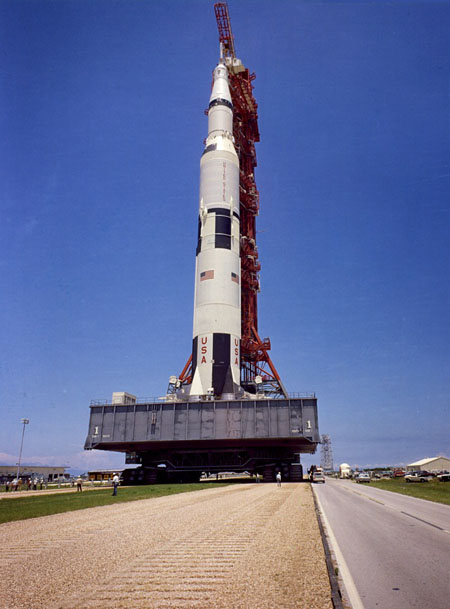
The Saturn V and Mobile Launch Platform are carried to the launch pad on the Crawler Transporter. Notice the tiny humans below the platform.
|
|||||||